



A vehicle may qualify for lemon law in California when it has a significant warranty-covered problem that the manufacturer or its authorized repair facility has been unable to fix after a reasonable opportunity to do so.
But qualification is not based on one simple rule.
The type of defect matters. The number of repair attempts matters. The amount of time your vehicle has spent unavailable because of repairs can matter. Your warranty and repair documentation can also play an important role.
That means you should not automatically assume your vehicle does—or does not—qualify simply because it has been repaired a certain number of times.
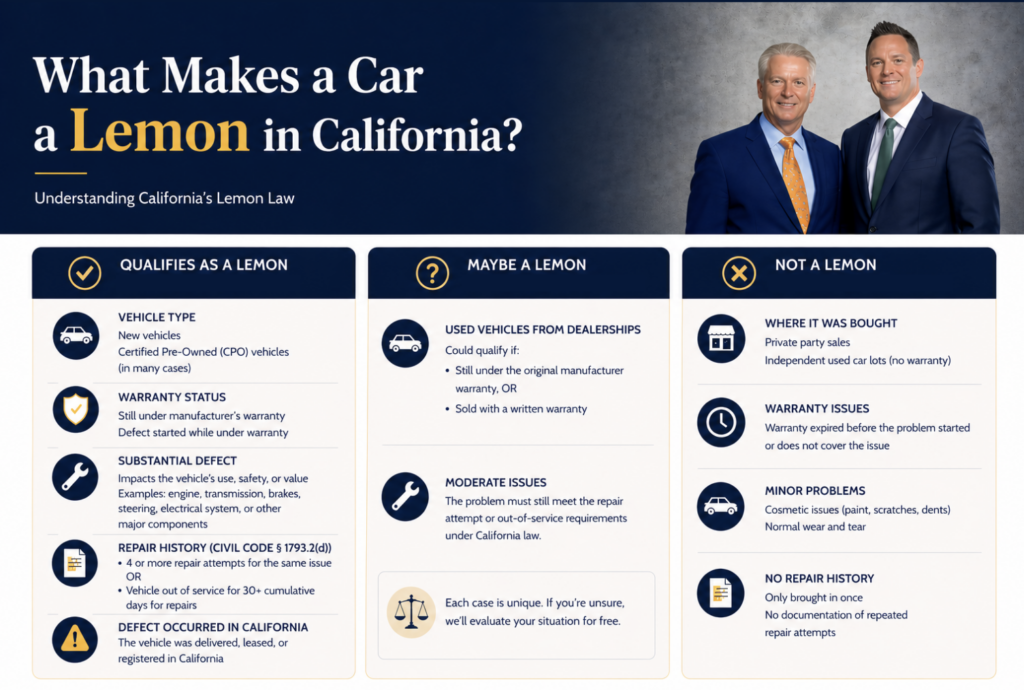
What Qualifies a Car for Lemon Law in California?
In most cases, a California lemon law claim involves a vehicle with a warranty-covered defect that substantially affects its use, value, or safety and remains unresolved after the manufacturer has been given a reasonable opportunity to repair it. Multiple repair attempts or extended time out of service can strengthen a potential claim.
California’s consumer warranty protections are designed to prevent vehicle owners from being stuck indefinitely with a defective vehicle that cannot be brought into conformity with its applicable warranty.
The central question is usually not:
“Has my vehicle broken down?”
It is:
“Has the manufacturer had a reasonable opportunity to correct a significant warranty problem and failed to do so?”
That distinction is important.
A single minor inconvenience generally presents a very different situation from recurring transmission failure, steering problems, electrical shutdowns, braking issues, engine defects, or another problem that substantially affects your ability to safely and reliably use the vehicle.
California Lemon Law Requirements You Should Know
There is no universal checklist that automatically makes every vehicle a lemon. However, several factors frequently determine whether a California vehicle owner may have a valid claim.
The Vehicle Has a Warranty-Covered Problem
Warranty coverage is one of the most important pieces of a California lemon law case.
The problem generally needs to arise while the vehicle is covered by an applicable manufacturer’s warranty.
That does not mean your warranty must still be active when you finally pursue your claim. A defect that first appeared and was presented for repair during the applicable warranty period may still be relevant even if the warranty later expires.
This is why repair orders can become so important. They establish a timeline showing when you first reported the problem, what you reported, and what the dealership attempted to do about it.
The Defect Substantially Affects Use, Value, or Safety
Not every defect makes a vehicle a lemon.
Generally, the problem must substantially impair the vehicle’s:
- Use: Does the problem prevent you from reliably using the vehicle as intended?
- Value: Would the unresolved defect materially reduce what the vehicle is worth?
- Safety: Does the defect create a meaningful safety concern for you, your passengers, or others?
Some defects can affect more than one category.
For example, an SUV that repeatedly loses power while driving may be less useful, less valuable, and potentially unsafe.
The Manufacturer Has Had a Reasonable Opportunity to Repair It
Manufacturers generally must be given a reasonable opportunity to correct the warranty-covered problem.
The important phrase is “reasonable opportunity.”
There is not one repair-attempt number that applies identically to every California lemon law case.
A serious braking problem may be evaluated differently from a malfunctioning infotainment system. The severity of the defect, repair history, days unavailable for use, and circumstances surrounding each repair can all matter.
If you have taken your vehicle back repeatedly for the same unresolved problem, it may be time to find out whether your vehicle qualifies for California lemon law.
How Many Repair Attempts Are Required for California Lemon Law?
One of the biggest misconceptions about California lemon law is that every consumer must reach an exact number of repair attempts before taking action.
That is not necessarily how qualification works.
California law focuses on whether the manufacturer received a reasonable number of opportunities to repair the vehicle.
Certain circumstances can also create a legal presumption that a vehicle qualifies under California’s lemon law. The applicable requirements are more specific than simply saying, “three repairs means you have a lemon.”
Serious Safety Problems Can Change the Analysis
Safety-related defects deserve particular attention.
Examples can include problems involving:
- Brakes
- Steering
- Airbags
- Sudden loss of power
- Vehicle stalling
- Unexpected acceleration
- Certain battery or electrical failures
- Safety restraint systems
A defect that could cause serious bodily injury or death may require fewer unsuccessful repair attempts under California’s lemon law presumption than other substantial defects.
You should therefore avoid continuing to drive an unsafe vehicle simply because you believe you need to accumulate additional repair attempts for a lemon law claim.
What Is the California Lemon Law 30-Day Rule?
The 30-day rule is another frequently misunderstood part of California lemon law.
Generally, one circumstance relevant to California’s lemon law presumption involves a vehicle being out of service because of warranty repairs for more than 30 cumulative calendar days since delivery, subject to the statutory requirements and exceptions.
The days generally do not have to occur during one continuous repair visit.
For example:
- Repair visit one: 8 days
- Repair visit two: 11 days
- Repair visit three: 7 days
- Repair visit four: 6 days
That would equal 32 cumulative days.
But reaching 30 days should not be treated as the only way to have a potential lemon law claim. Likewise, simply counting 30 days without examining why the vehicle was unavailable and whether the other legal requirements are satisfied can lead to the wrong conclusion.
What Types of Vehicle Problems May Qualify Under California Lemon Law?
California lemon law is not limited to catastrophic engine failures.
The issue is generally the effect of the defect and the manufacturer’s inability to successfully repair it, rather than the name of the defective component.
Engine Problems
Potential engine-related issues include:
- Repeated stalling
- Loss of power
- Excessive oil consumption
- Overheating
- Misfiring
- Failure to start
- Check-engine warnings associated with recurring defects
An engine problem that keeps returning after warranty repairs deserves careful documentation.
Transmission Problems
Transmission complaints can include:
- Hard shifting
- Delayed acceleration
- Slipping
- Jerking
- Failure to engage
- Unexpected loss of power
- Transmission warning messages
Because transmission defects can affect both drivability and safety, persistent transmission problems can be particularly important in a lemon law evaluation.
Electrical Problems
Modern vehicles rely heavily on interconnected electrical systems and software.
Potential problems can include:
- Vehicle unexpectedly shutting down
- Battery or charging failures
- Repeated warning lights
- Screens or controls failing
- Electrical accessories malfunctioning
- Sensors repeatedly failing
- Software-related vehicle functions not operating properly
Electrical problems should not automatically be dismissed because the vehicle still technically drives. A recurring electrical defect may materially affect the vehicle’s use, safety, or value depending on its severity.
Brake and Steering Defects
Brake and steering problems can create obvious safety concerns.
Repeated brake failure, steering loss, abnormal steering behavior, or unsuccessful attempts to correct a serious safety defect should be documented carefully.
Air Conditioning and Climate-Control Problems
Even climate-control defects can potentially become significant.
The question is whether the issue substantially affects the vehicle’s use or value under the circumstances.
For example, repeated failure of an important climate-control system may be more than a minor inconvenience, particularly when multiple repairs fail to solve the underlying defect.
EV and Hybrid Vehicle Problems
Electric and hybrid vehicles introduce another group of potentially significant defects, including problems involving:
- High-voltage batteries
- Charging systems
- Unexpected power loss
- Range-related malfunctions
- Thermal management
- Electric drive systems
- Vehicle software
- Repeated error messages
The technology may be different, but the central lemon law questions remain similar: Is there a covered defect, how significantly does it affect the vehicle, and has the manufacturer been able to repair it within a reasonable opportunity?
Can a Used Car Qualify for Lemon Law in California?
Yes, some used vehicles may qualify for California lemon law protection, but warranty status and the circumstances of the sale matter.
Buying a used vehicle does not automatically eliminate every lemon law right.
For example, certain used or certified pre-owned vehicles may have remaining manufacturer warranty protection or other applicable written warranty coverage.
Used-vehicle cases can become fact-specific quickly, so you should have the warranty documents and purchase agreement reviewed rather than assuming a used vehicle is automatically excluded.
Do Minor Problems Qualify for California Lemon Law?
Sometimes—but the severity and impact of the problem matter.
A small cosmetic imperfection that does not meaningfully affect the vehicle’s use, value, or safety is unlikely to present the same case as repeated engine stalling.
But a problem that initially sounds “minor” can become significant when it repeatedly returns.
Consider an electronic defect.
One temporary screen freeze may be an inconvenience. Repeated electrical failures that disable essential controls, safety systems, cameras, or other vehicle functions may present a much different situation.
The better question is not whether the dealership calls the problem minor.
Ask:
How does this unresolved defect actually affect my ability to use, value, or safely operate the vehicle?
Does Your Vehicle Have to Be Brand New to Qualify?
Not necessarily.
Consumers often associate lemon law exclusively with brand-new vehicles, but California warranty law can apply in additional circumstances.
The vehicle’s age alone does not answer the question.
Warranty coverage, when the defect first arose, when the vehicle was presented for repair, the nature of the transaction, and the specific facts surrounding the vehicle all need to be considered.
If you are unsure about an older or pre-owned vehicle, a California lemon law attorney can review the warranty and repair timeline before you rule out a potential claim.
What Can Prevent a Vehicle From Qualifying?
Not every recurring vehicle problem is the manufacturer’s legal responsibility.
A potential claim can become more difficult when the problem results from something outside the manufacturer’s warranty obligations, such as:
- Vehicle abuse
- Lack of required maintenance
- Collision damage
- Certain aftermarket modifications
- Unauthorized repairs
- Damage unrelated to a manufacturing or warranty-covered defect
Manufacturers may argue that one of these factors caused the problem.
That makes documentation especially important when there is disagreement about why the vehicle is malfunctioning.
What Documentation Helps Determine Whether Your Car Qualifies?
Start building your records as soon as a recurring problem develops.
Keep copies of:
- Purchase or lease documents
- Warranty information
- Every repair order
- Dealership invoices
- Dates the vehicle entered and left the shop
- Mileage at each repair
- Emails and text messages with the dealership
- Communications with the manufacturer
- Photographs or videos of intermittent problems
- Towing records
- Manufacturer case numbers
Pay particular attention to the customer complaint listed on each repair order.
If you tell the service department, “The vehicle loses power while accelerating,” but the paperwork only says “customer requests inspection,” ask for the complaint to be documented accurately.
Your repair history can become one of the most important pieces of evidence in determining whether the manufacturer had a reasonable opportunity to fix the defect.
What Happens If Your Vehicle Qualifies as a Lemon in California?
A qualifying California lemon law claim may result in different remedies depending on the circumstances.
Two of the most important potential outcomes are a manufacturer repurchase, commonly called a buyback, or replacement of the vehicle. Other resolutions may be possible depending on the claim and what the consumer chooses to pursue.
California Lemon Law Buyback
A California lemon law buyback generally involves the manufacturer repurchasing a qualifying defective vehicle.
The calculation is more detailed than simply refunding whatever you have paid.
Depending on the circumstances, the calculation may account for qualifying payments and charges as well as a statutory mileage offset based on use before the defect was first presented for correction.
Because these calculations can become significant, you should review the numbers carefully before accepting a manufacturer offer.
Replacement Vehicle
Replacement can also be an available remedy in qualifying circumstances.
Whether replacement makes sense depends on your goals, the proposed vehicle, financing considerations, and the terms of the resolution.
Other Settlements
Some disputes resolve through negotiated monetary settlements in which the consumer keeps the vehicle.
That can be attractive in certain situations, but you should understand exactly what rights you are releasing before accepting a settlement.
How to Determine Whether You Have a California Lemon Law Claim
If you are repeatedly returning to the dealership, use this process to organize your situation.
Step 1: Identify the recurring defect. Write down exactly what the vehicle is doing and when it happens.
Step 2: Review your warranty. Determine whether the problem arose during applicable warranty coverage.
Step 3: Count repair attempts. Review how many times the vehicle has been presented for the same or related problems.
Step 4: Calculate days unavailable for use. Add the time the vehicle has spent out of service because of repairs.
Step 5: Assess the impact. Consider how significantly the defect affects use, value, or safety.
Step 6: Gather every repair order. Do not rely solely on your memory or dealership records.
Step 7: Have the case evaluated. Lemon law eligibility is highly fact-specific. A professional review can help determine whether your repair history supports a claim.
My Lemon Firm offers a free case review with no upfront cost to get started. If you are unsure whether you have enough repairs or whether your defect is serious enough, you can start your free California lemon law case review.
What Most California Vehicle Owners Get Wrong About Lemon Law
One of the biggest mistakes is waiting for the dealership to officially declare the vehicle a lemon.
That generally is not how the process works.
Consumers also commonly assume:
- They need exactly four repair attempts.
- Their vehicle must spend exactly 30 days in the shop.
- The vehicle must stop running completely.
- Only new vehicles can ever qualify.
- They cannot pursue a claim after the warranty expires.
- Every problem must involve a major mechanical component.
Those assumptions can cause consumers with potentially valid claims to give up too early.
The full repair history matters more than any single shortcut.
When Should You Speak With a California Lemon Law Attorney?
You do not need to know with certainty that your vehicle qualifies before speaking with an attorney.
Consider having your situation evaluated when:
- The same problem keeps returning.
- The dealership says it cannot reproduce the problem.
- Repairs temporarily work before the defect returns.
- Your vehicle has spent significant time in the shop.
- You are concerned about the vehicle’s safety.
- The manufacturer has opened a case but has not resolved the problem.
- You have been offered a buyback or settlement.
- You are unsure whether your warranty or used vehicle qualifies.
An attorney can evaluate your repair history, warranty, vehicle documentation, and communications with the manufacturer to determine what options may be available.
My Lemon Firm focuses on California lemon law claims and offers consumers a free case review with no upfront cost to begin the evaluation.
Find out if your vehicle may qualify.
Frequently Asked Questions About What Qualifies for Lemon Law in California
How many times does a car need to be repaired to qualify for lemon law in California?
There is no single repair number that determines every California lemon law claim. The law generally examines whether the manufacturer received a reasonable opportunity to repair a substantial warranty-covered defect. The severity of the problem, number of attempts, safety implications, and time the vehicle was unavailable can all affect the analysis.
Does 30 days in the shop automatically make my car a lemon in California?
No, not automatically. More than 30 cumulative calendar days out of service for warranty repairs can be important under California’s lemon law presumption when the applicable statutory requirements are met. However, qualification still depends on the circumstances, and consumers may potentially qualify through other repair histories as well.
Can a used vehicle qualify for California lemon law?
Yes, in some cases. Used vehicles can potentially receive California lemon law protection depending on applicable warranty coverage and the circumstances of the sale and repairs. Certified pre-owned and other used vehicles with relevant warranty protection should be evaluated individually rather than automatically excluded because they were purchased used.
Can I qualify if my vehicle’s warranty has already expired?
Potentially. A claim may still be possible when the relevant defect arose and the vehicle was presented for repair while applicable warranty coverage was in effect. An expired warranty therefore does not automatically mean you waited too long, although legal deadlines and the individual repair timeline still matter.
Does a safety problem automatically qualify my vehicle as a lemon?
No. A serious safety defect is highly relevant, but the existence of a safety problem alone does not automatically establish a lemon law claim. The warranty, repair attempts, severity of the defect, manufacturer’s opportunity to repair it, and other circumstances should be evaluated together.
Find Out Whether Your Vehicle Qualifies for California Lemon Law
You do not need to become an expert in California warranty law before asking for help.
If your vehicle keeps returning to the dealership for the same problem, has experienced a serious safety defect, or has spent substantial time unavailable because of warranty repairs, your repair history deserves a closer look.
The sooner you organize your repair orders and warranty records, the easier it becomes to understand your options.
My Lemon Firm provides free case reviews for California consumers, with no upfront cost to get started.
Start your free case review and find out whether your vehicle may qualify under California lemon law.