



Buying or leasing a vehicle should not mean repeatedly returning to the dealership for the same unresolved problem. When a vehicle has significant warranty-covered defects that the manufacturer cannot repair within a reasonable number of opportunities, the California lemon law process may give the owner or lessee legal remedies.
California Lemon Law is primarily governed by the Song-Beverly Consumer Warranty Act. Depending on the circumstances, a qualifying consumer may be entitled to a manufacturer buyback or replacement vehicle.
Understanding the process early can also help you avoid mistakes that make a legitimate claim harder to document.
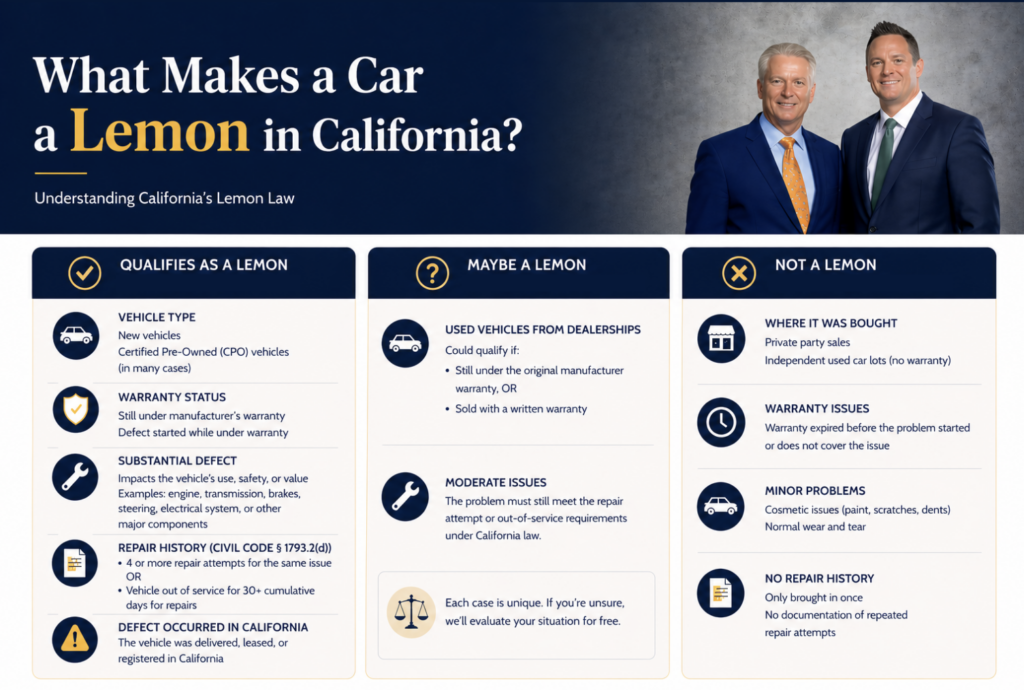
How Does the California Lemon Law Process Work?
The California lemon law process generally starts when a vehicle develops a warranty-covered defect and the manufacturer or its authorized repair facility receives reasonable opportunities to fix it. If the problem substantially affects the vehicle’s use, value, or safety and cannot be repaired, the consumer may pursue a manufacturer buyback, replacement, or other available compensation.
California’s Attorney General explains that the law generally protects qualifying vehicles with defects that cannot be repaired after a reasonable number of attempts. What counts as “reasonable” depends on the circumstances of the individual vehicle and defect.
Step 1: A Significant Vehicle Problem Develops
A lemon law case normally begins with a defect.
Not every inconvenience automatically makes a vehicle a lemon. The issue generally needs to be covered by the applicable manufacturer’s warranty and substantially impair the vehicle’s use, value, or safety.
Potential problems can include:
- Engine or powertrain failures
- Transmission problems
- Electrical system defects
- Battery or charging problems in electric vehicles
- Steering or braking issues
- Stalling or loss of power
- Recurring warning lights
- Infotainment or electronic failures
- Water leaks
- Safety-system malfunctions
The specific defect matters, but so does its severity, frequency, repair history, and impact on the vehicle.
Step 2: Take the Vehicle to an Authorized Repair Facility
One of the most important parts of a lemon law claim in California is creating a clear repair history.
When a problem develops, take the vehicle to the manufacturer’s authorized repair facility and explain the symptoms as specifically as possible.
Instead of simply saying, “The car isn’t driving correctly,” explain exactly what happens.
For example:
“Vehicle loses acceleration while entering the freeway and displays a powertrain warning message.”
Detailed complaints help technicians diagnose the vehicle and create documentation showing what you experienced.
Keep Every Repair Order
Save copies of your repair orders, invoices, dealership communications, towing records, photographs, videos, and other relevant documents.
Review the repair order before leaving the dealership. Make sure it accurately describes the problem you reported, the work performed, and the dates or mileage associated with the visit.
Learn what qualifies as a lemon in California →
Step 3: Give the Manufacturer a Reasonable Opportunity to Repair the Vehicle
California does not impose one universal number of repair attempts that automatically makes every defective vehicle a lemon.
Instead, the circumstances matter.
California does have a legal presumption that can apply under specific circumstances. Among other requirements, the defect must arise within the first 18 months after delivery or 18,000 miles, whichever occurs first. Depending on the problem, the presumption can involve four or more repair attempts for the same issue, two or more attempts for a defect likely to cause death or serious bodily injury, or the vehicle being out of service for repairs for more than 30 cumulative days.
Those numbers should not be interpreted as universal minimum requirements for every California lemon law case. A vehicle can potentially qualify outside the presumption depending on its repair history and circumstances.
How many repair attempts are needed under California Lemon Law? →
Step 4: Determine Whether the Defect Substantially Impairs the Vehicle
A major question is how the unresolved defect affects the vehicle’s use, value, or safety.
Consider a vehicle that repeatedly loses power while driving. Even if technicians temporarily restore normal operation, repeated loss of acceleration could create a serious safety concern.
Another vehicle may repeatedly experience an electrical failure that prevents it from starting. The defect may not create the same immediate highway safety concern, but repeated failures could substantially affect the vehicle’s use and value.
Every situation needs to be evaluated based on the actual defect and repair history.
Step 5: Organize the Lemon Law Evidence
Before pursuing a claim, organize your documentation.
A useful file should contain the purchase or lease agreement, warranty information, repair orders, service invoices, dealership communications, manufacturer communications, towing receipts, rental vehicle records, and photographs or videos documenting the defect.
You should also create a simple timeline showing:
Date → Mileage → Problem → Repair Attempt → Days Out of Service → Result
This makes it much easier to see whether a pattern has developed.
Do Not Rely Only on Dealership Records
Keep your own copies.
Dealership descriptions can occasionally be incomplete or use terminology that does not fully reflect what the consumer reported. Your emails, text messages, photographs, videos, and personal timeline can provide additional context.
Step 6: Evaluate Whether the Vehicle May Qualify
At this stage, the question becomes whether the repair history potentially satisfies California Lemon Law requirements.
Important factors can include:
- Whether the vehicle is covered by an applicable manufacturer’s warranty
- When the defect first appeared
- How serious the defect is
- How many repair opportunities occurred
- Whether the same or related problems keep returning
- How many days the vehicle spent out of service
- Whether the defect substantially affects use, value, or safety
- Whether improper or unauthorized use caused the problem
California’s Attorney General notes that most new vehicles purchased or leased in California and covered by a manufacturer’s new-vehicle warranty can fall within the law. Certain used vehicles may also be covered when the manufacturer’s new-car warranty applies.
Not sure whether your repair history is enough? Start your free case review with My Lemon Firm. There is no upfront cost to have your situation evaluated, and a California lemon law attorney can review the actual repair history rather than relying on a generic online checklist.
Start your free California Lemon Law case review →
Step 7: Present the Claim to the Manufacturer
If the facts support a potential claim, the manufacturer can be put on notice that the consumer is seeking relief under California law.
This is where having organized documentation becomes especially valuable.
The manufacturer may review repair orders, warranty information, mileage, ownership documents, and the history of the defect before determining how it will respond.
Some claims may be resolved through negotiation. Others can become disputed.
Manufacturers may also offer state-certified arbitration programs for warranty disputes. California’s Attorney General describes arbitration as one possible avenue for resolving certain lemon law disputes.
Consumers should understand the consequences of any settlement, arbitration, release, or other agreement before accepting it.
Step 8: Determine the Appropriate Remedy
If a vehicle qualifies as a lemon, two major remedies are repurchase and replacement.
Manufacturer Buyback
A buyback generally means the manufacturer takes the defective vehicle back and provides restitution calculated according to California law.
The exact calculation can depend on the purchase or lease, payments, qualifying expenses, mileage, and other case-specific factors.
How the California Lemon Law buyback process works →
Replacement Vehicle
Replacement may also be available in qualifying situations.
However, California’s Attorney General specifically notes that consumers have the right to choose a refund rather than being forced to accept a replacement.
Lemon Law buyback vs. replacement vehicle →
Step 9: Negotiate or Escalate a Disputed Claim
Not every manufacturer immediately agrees that a vehicle qualifies.
A manufacturer may dispute whether:
- Enough repair opportunities occurred
- The problem is substantial
- The defect is covered by warranty
- Different repair visits concern the same underlying problem
- The manufacturer is responsible for the condition
- The requested compensation is appropriate
This is one point where speaking with a California lemon law attorney can become especially important.
An attorney can evaluate the evidence, communicate with the manufacturer, calculate potential recovery, negotiate a resolution, and determine whether further legal action is appropriate.
Step 10: Resolve the Claim
A successful California lemon law case does not necessarily require a trial.
Depending on the circumstances, claims may resolve through manufacturer negotiations, settlement, arbitration, or litigation.
The appropriate path depends on the facts of the case and how the manufacturer responds.
What matters is that consumers understand what they are agreeing to before signing a settlement or release.
What Should You Do If You Think Your Vehicle Is a Lemon?
Start documenting the situation immediately.
Continue reporting legitimate recurring problems, retain your paperwork, and avoid modifying or repairing the vehicle in ways that could complicate determining the cause of the defect.
Most importantly, do not assume you must reach a specific number of dealership visits before asking an attorney to review the case.
California’s “reasonable number” standard depends on the circumstances, and the familiar 2-, 4-, and 30-day benchmarks relate to a statutory presumption rather than a universal qualification rule.
Find Out If Your Vehicle Qualifies
My Lemon Firm helps California vehicle owners understand whether recurring warranty problems may support a lemon law claim. You can start with a free case review, speak directly with a California lemon law attorney, and learn what options may be available without an upfront legal cost.
Speak with a California Lemon Law attorney →
Frequently Asked Questions About the California Lemon Law Process
How many repair attempts does California Lemon Law require?
There is no single repair-attempt number that applies to every case. California uses a reasonable-opportunity standard based on the circumstances. A statutory presumption can apply in certain cases involving four repair attempts, two attempts for qualifying serious safety defects, or more than 30 cumulative days out of service, along with additional requirements.
Does a vehicle automatically qualify after 30 days in the shop?
No. More than 30 cumulative days out of service can help establish California’s lemon law presumption when the other legal requirements are satisfied, but 30 days is not an automatic rule guaranteeing that every vehicle qualifies. The warranty, defect, timing, repair history, and other circumstances still matter.
Can a used vehicle qualify under California Lemon Law?
Yes, in some cases. California’s Attorney General states that the Lemon Law can apply to used vehicles when a manufacturer’s new-car warranty was issued with the sale. Used-vehicle cases can be more fact-specific, so the warranty documents and circumstances of the sale should be reviewed carefully.
Do I have to accept a replacement vehicle?
No. When California Lemon Law requires the manufacturer to repurchase or replace a qualifying vehicle, the California Attorney General states that the consumer has the right to choose a refund instead of a replacement. The financial details of a buyback will depend on the facts of the individual case.
When should I contact a California lemon law attorney?
You do not necessarily need to wait until the dealership has attempted the same repair four times. If a serious warranty problem keeps returning, the vehicle has spent substantial time in the shop, or you are concerned about its safety or reliability, an attorney can review the repair history and determine whether a claim may already exist.
Understanding the Process Can Protect Your Claim
The California lemon law process is fundamentally about the vehicle’s warranty, the defect, the manufacturer’s opportunities to repair it, and the evidence documenting what happened.
If your vehicle repeatedly returns to the dealership without a lasting repair, waiting indefinitely may not be your only option.
Start your free case review with My Lemon Firm to find out whether your vehicle may qualify under California Lemon Law. There is no upfront cost to have your situation reviewed, and understanding your rights early can help you make a more informed decision about what to do next.