



Quick answer: California’s Lemon Law is part of the Song-Beverly Consumer Warranty Act (Civil Code § 1790 and following). It may require a vehicle manufacturer to repurchase or replace a car, truck, or SUV when a defect covered by the manufacturer’s warranty substantially affects the vehicle’s use, value, or safety and the manufacturer cannot fix it after a reasonable number of repair opportunities. A prevailing consumer can also recover attorney fees from the manufacturer. Last reviewed by Brian Murray, November 2026.
When you buy or lease a car, you expect it to be safe and reliable. Sometimes, though, a vehicle has defects that just don’t go away, even after repeated trips to the dealership. That is where California’s Lemon Law may apply and give you a legal remedy.
If your vehicle has a serious issue that the manufacturer or its dealership cannot fix after a reasonable number of attempts, you may be entitled to a refund, a replacement, or another financial recovery. At My Lemon Firm, our California lemon law attorneys have years of experience standing up for drivers across the state. We understand how frustrating it can be to deal with constant repairs and unhelpful dealerships, and we want to be there to help. Call (844) 40-LEMON for a free case review.
How Does California’s Lemon Law Work?
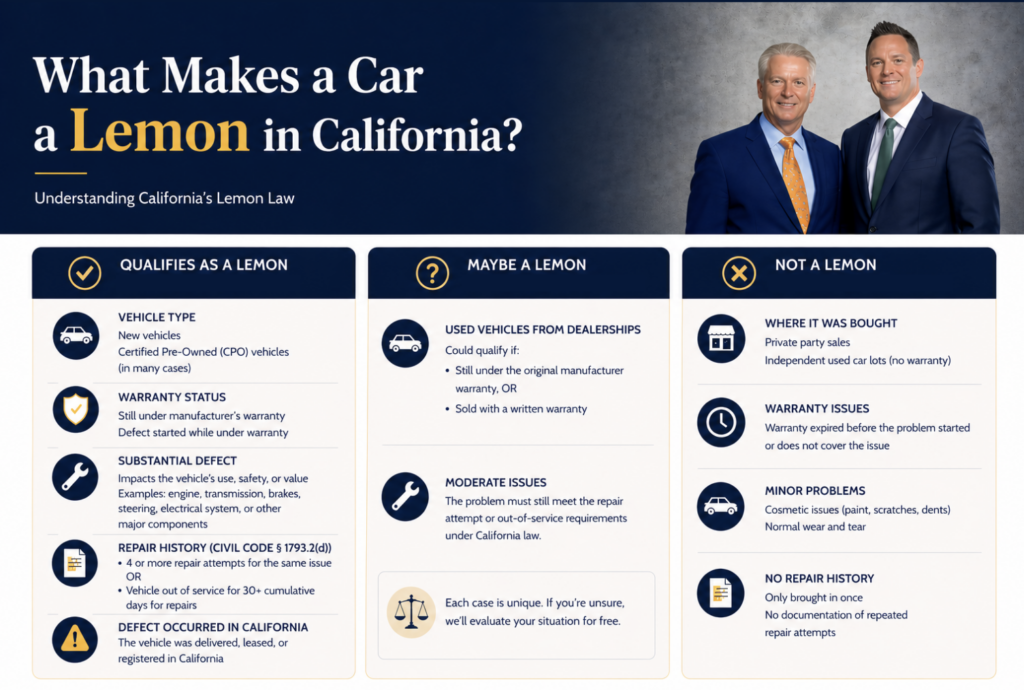
The Lemon Law is part of the Song-Beverly Consumer Warranty Act, one of the strongest consumer protection statutes in the country. It generally applies to vehicles covered by the manufacturer’s warranty. For a vehicle to qualify as a “lemon,” three conditions usually need to be met:
- The vehicle has a defect covered by the manufacturer’s warranty.
- The manufacturer or its authorized repair facility has had a reasonable number of chances to fix it.
- The defect substantially affects the vehicle’s use, value, or safety.
When those conditions are met, the manufacturer may be required to replace the vehicle or refund what you paid, and the consumer generally chooses which. The law also lets a prevailing consumer recover reasonable attorney fees and costs under Civil Code § 1794. See what qualifies as a lemon in California.
What Is the Lemon Law Presumption?
The Tanner Act, found in Civil Code § 1793.22, creates a presumption that the manufacturer had a reasonable number of repair opportunities if, within 18 months or 18,000 miles of delivery:
- The same defect, likely to cause death or serious injury, was subject to repair two or more times;
- The same defect was subject to repair four or more times; or
- The vehicle was out of service for warranty repairs for more than 30 cumulative days.
These numbers are a helpful benchmark, not a requirement. Many valid claims fall outside the presumption. What is a reasonable number of repair attempts?
What Vehicles Does California’s Lemon Law Cover?
The refund-or-replace remedy covers “new motor vehicles,” which include:
- New cars, trucks, vans, and SUVs bought or leased primarily for personal, family, or household use
- Leased vehicles
- Dealer-owned and demonstrator vehicles sold with a manufacturer’s new-car warranty
- The chassis, cab, and drivetrain of a motorhome
- Certain business vehicles, depending on weight and fleet size
Motorcycles, off-road vehicles, and the living quarters of motorhomes are excluded from that definition, though Song-Beverly’s broader warranty protections can still apply to them and to products such as boats.
Used vehicles. In Rodriguez v. FCA US, LLC (October 31, 2024), the California Supreme Court held that a used car sold with time remaining on the original factory warranty is not a “new motor vehicle” for the refund-or-replace remedy. Whether a used or certified pre-owned vehicle qualifies now depends heavily on what warranty was issued with the sale. Other warranty claims may still be available, so have the purchase documents reviewed before assuming you have no case.
What Defects Can Lead to a Lemon Law Claim?
Not every problem rises to the level of a lemon. The defect usually must be substantial, safety-related, or persistent. Examples include:
- Engine or transmission failure
- Electrical system malfunctions
- Brake or steering issues
- Faulty airbags or seatbelts
- Persistent stalling or loss of power
- Water leaks and mold problems
- Defective sensors, cameras, or warning systems
- EV battery and charging failures
If these or similar issues continue after repeated repair attempts, you may have a case worth pursuing. See common defects in newer cars.
What Can You Recover Under the Lemon Law?
If your vehicle qualifies, the remedies may include:
- Refund (buyback): reimbursement of your down payment, monthly payments, taxes, registration, and incidental costs such as towing or rental cars, minus a statutory mileage offset.
- Replacement vehicle: a substantially similar vehicle from the manufacturer.
- Cash and keep: a negotiated settlement that lets you keep the vehicle.
- Civil penalty: up to two times actual damages when a manufacturer willfully violates the law.
Manufacturers are also responsible for a prevailing consumer’s reasonable attorney fees. Who pays lemon law attorney fees?
What Changed in California’s Lemon Law in 2025?
AB 1755 (signed September 2024) and SB 26 (signed April 2025) created a new procedure that manufacturers can choose to opt into. For opted-in manufacturers:
- Written demand first. A consumer who sends a written repurchase or replacement demand at least 30 days before suing must receive an offer within 30 days, and the manufacturer must complete the buyback or replacement within 60 days.
- Shorter filing deadlines tied to warranty expiration and the vehicle’s delivery date.
- Early mediation and faster evidence exchange once a case is filed.
- Fee disputes over pre-litigation settlements go to binding arbitration.
Manufacturers that did not opt in remain under the traditional Song-Beverly rules. The state publishes the list of opted-in manufacturers. Which track applies to you depends on your manufacturer, so the rules are more structured but also more complex.
How Long Do You Have to File a Lemon Law Claim?
It depends on your manufacturer and your dates. Under the new opt-in procedure, deadlines are shorter and run from warranty expiration and vehicle delivery; under the traditional rules, a longer statute of limitations generally applies. Because the answer can change your case, contact an attorney as soon as you suspect a problem. Learn about filing a lemon law claim in California.
How Can a California Lemon Lawyer Help?
Car manufacturers have legal teams working against you, and dealerships are often reluctant to admit when a car qualifies as a lemon. A lemon lawyer can:
- Review your warranty and repair history to see whether you may have a case
- Prepare and send any required written notice to the manufacturer
- Make sure you meet the deadlines that apply to your manufacturer
- Gather repair records, expert reports, and other evidence
- Negotiate directly with the manufacturer on your behalf
- Represent you in court if the case cannot be resolved through settlement
My Lemon Firm works on contingency, with no upfront attorney fees. See the full California lemon law process, step by step.
What Is Lemon Law? FAQs
Is “lemon law” the official name?
No. “Lemon law” is the common name for the vehicle provisions of California’s Song-Beverly Consumer Warranty Act, including the Tanner Consumer Protection Act in Civil Code § 1793.22.
Does the lemon law apply to the dealer or the manufacturer?
The repurchase or replacement obligation falls on the manufacturer that issued the warranty, not the selling dealership.
Do I have to use the manufacturer’s arbitration program?
Not always. Some manufacturers offer programs certified by the Department of Consumer Affairs, and using one can matter for the presumption. Talk to an attorney before you file or accept a decision.
Can I keep my car and still get money?
Sometimes. A cash-and-keep settlement is one possible resolution.
Is there a federal lemon law?
The federal Magnuson-Moss Warranty Act covers written warranties nationwide, but California’s Song-Beverly Act generally gives California consumers stronger remedies.
Contact My Lemon Firm for a Free Case Review
If you believe your car is a lemon, you deserve to know your options and your best path forward. California’s Lemon Law gives you real rights, but you may need an experienced lawyer to enforce them. At My Lemon Firm, we’ve dedicated our practice to helping consumers get fair outcomes after dealing with a defective vehicle. Contact us or call (844) 40-LEMON.